
The Old Sodium Light That Still Makes Sense
Low Pressure Sodium, Turtle-Safe LEDs, and Why White Floodlights May Not Be the Future We Think They Are
There is something about an orange light at night that feels out of time.
Not warm white. Not decorative amber. Not the soft fake candlelight of a porch bulb trying to look old-fashioned. I mean that deep, narrow, almost unreal orange-yellow glow of low pressure sodium. The kind of light that does not try to show you the world in full color. It does not flatter brickwork. It does not make grass look green. It does not make cars shine blue or red or silver.
It simply lights the ground.
For some people that is a flaw. For me, I think that may be the point.
I first remember really noticing that color while travelling down the Don Valley Parkway in Toronto. The DVP already has a particular feeling to it, a road cut through a river valley, forested slopes, concrete, traffic, curves, retaining walls, and city infrastructure all tangled together. At night, those old orange lights gave it a strange mood. It was urban, but not harsh. Industrial, but not cold. You were in the city, yet the light did not feel like it was trying to turn night into day.
At the time, I probably did not think much more than, “those lights are oddly orange.” But that color sticks in your mind. Later, I started noticing similar lighting in other places. Around beaches. Around sensitive areas. Around places where the goal was not to blast everything with a white LED floodlight, but to provide enough light while doing less damage to the night itself.
More recently, I even noticed that kind of amber/orange lighting at a corner store in Buffalo, around Fillmore and Main. That caught my attention because you do not expect to see that anymore. Most places have gone the other direction. Brighter. Whiter. Sharper. More LED. More glare. More “security light” energy.
But sometimes the old answer was not as obsolete as people thought.
Low pressure sodium is old technology. There is no getting around that. It is from another era of lighting. It has terrible color rendition. Under LPS, almost everything becomes some version of yellow, gray, brown, or black. If you need to identify paint colors, inspect wiring, read color-coded labels, or make a parking lot look like a car commercial, LPS is not your friend.
But for basic outdoor lighting, paths, porches, garages, yards, alleys, utility spaces, places where you mostly need to see shape, motion, steps, edges, and obstacles, the lack of color is not nearly the disaster people make it out to be.
And in exchange, you get something remarkable.
Low pressure sodium has historically reached very high luminous efficacy, often in the same broad conversation as modern LEDs, with published ranges around 50 to 160 lumens per watt depending on lamp and system conditions. That means this “old” technology can still compete with, and sometimes beat, many real-world LED floodlights once you stop comparing laboratory LED chips and start comparing actual installed fixtures, drivers, optics, glare losses, failed electronics, and overpowered fixtures.
That last part matters. A modern LED floodlamp may look efficient on the box, but a lot of outdoor LED lighting is not installed with restraint. People replace a moderate old fixture with a blinding white panel that throws light sideways, upward, into windows, into trees, into the eyes of drivers, and into the sky. The fixture may be “efficient,” but the application is wasteful.
Low pressure sodium is different. It is narrow-spectrum light. It does not pretend to be daylight. It gives you that orange line of visibility and leaves much of the night alone.
I have always been interested in lighting. Collecting various flashlights, various emergency response 'flighing lights', strobes, halogen, LED. I even installed HPS and HID lighting along with newer commercial grade LED lighting around my house. And the one style of lighting I had been desiring, but missing for the longest time was an LPS style light. The reason I held off was simply lack of parts for a reasonable price. But I recently found a source for some newer LED turtle friendly products which offer a simiar feel.
That is also why turtle-safe LED lighting interests me. The newer amber and turtle-safe LEDs are, in some ways, a modern attempt to recover something that older sodium lighting already understood by accident or by physics. Turtle-friendly lighting standards focus heavily on reducing short-wavelength light, especially blue and blue-green light. Florida wildlife guidance, for example, emphasizes shielding, directing light downward, and avoiding scattered light that can disorient sea turtles. Some turtle-friendly LED products are designed to limit short-wavelength output below about 560 nanometers, which is very different from a typical cool white LED that has a large blue-heavy component.
That idea matters far beyond turtles.
Night is not just darkness with the lights turned off. Night is habitat. It is navigation. It is feeding time. It is mating time. It is migration. It is rest. It is concealment. It is part of the natural rhythm that animals, insects, birds, amphibians, and even plants evolved around.
White light, especially blue-rich white LED light, is disruptive in ways we are only slowly admitting. It reaches farther than people think. It scatters more. It changes how insects behave. It changes predator-prey relationships. It attracts bugs, which attracts spiders, which changes the little ecosystem around a building.
That is not abstract to me. That is one of the main reasons I started caring about this at my own house.
A white LED porch light does not just light the porch. It becomes a beacon. Bugs collect around it. Spiders follow the bugs. Webs show up in the corners, around the door, around the siding, around the fixtures. Then you are not just dealing with lighting anymore. You are dealing with an artificial feeding station strapped to the side of your house.
Studies have found that broad-spectrum white lights, including white LEDs and metal halide lights, can attract a greater diversity of insects than longer-wavelength sodium-style lighting. That matches what a lot of people have seen with their own eyes. White light brings life to it, but not always in a healthy way. It pulls insects out of the dark and concentrates them where they do not belong.
So for my porch, the choice was not just about saving a few watts. It was about changing the relationship between the house and the night.
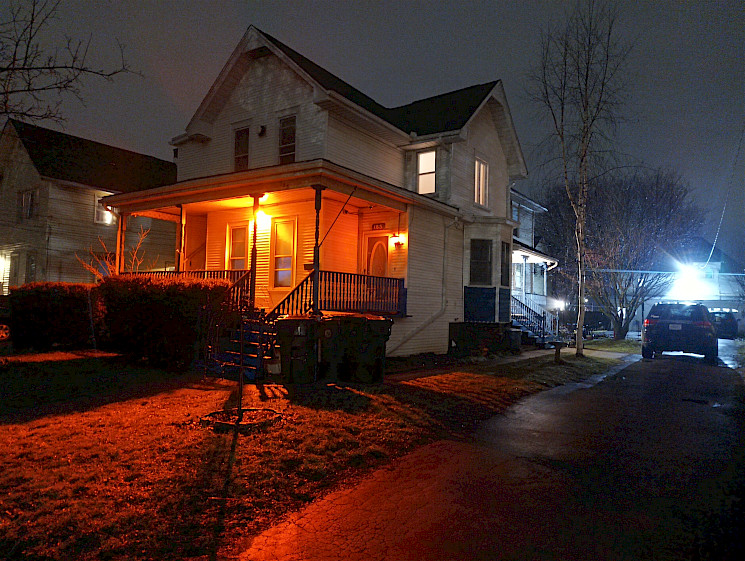
I chose to install a newer turtle-safe amber LED at my house. Not because I live on a turtle nesting beach (ha I wish.. kinda), but because the principle is right. Keep the light low. Keep it warm. Keep it shielded. Use only what is needed. Avoid blue-heavy light. Do not turn the side of the house into a miniature stadium.
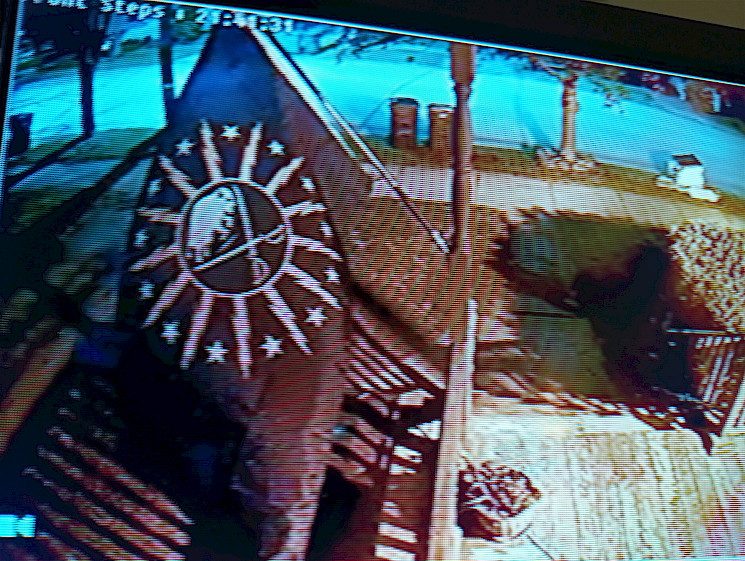
The result is calmer. The porch is still usable. I can see where I am walking. I can see the door. I can see enough. The other important aspect is that it doesn't seem to effect camera coverage at all. Of the three cameras covering my porch two remain in color mode at night while one does switch to black and white, but has excellent visibility. It also no longer feels like I am blasting the entire yard (and neighbors) with white light just because LEDs made it cheap to do so.
And that is the trap with modern LED outdoor lighting.
LEDs are not bad. In fact, they are one of the most important lighting technologies ever developed. They can be efficient, compact, dimmable, directional, and long-lasting when they are well designed. Dark-sky groups now recommend warmer lighting, including 2200K, phosphor-converted amber, or filtered LEDs when possible, especially where ecological impact matters.
The problem is not LED itself. The problem is how people use it.
Too many outdoor LED fixtures are too white, too bright, too glary, and too disposable. They are sold as long-life fixtures, but in the real world many fail because of cheap drivers, heat stress, water intrusion, flickering electronics, color shift, or partial diode failure. The old lamp-and-ballast world had its own problems, but at least a failed bulb was often just a failed bulb. A lot of modern LED fixtures become e-waste when the driver goes or the sealed unit starts flickering like a haunted gas station canopy.
That makes me question the true life-cycle savings.
A high pressure sodium or HID fixture may be power hungry compared to a good LED. Metal halide, mercury vapor, high pressure sodium, all of those older discharge lights have losses, warm-up times, ballasts, and maintenance concerns. HPS was everywhere for a reason, but it still throws a broader amber-white light than LPS and does not have the same narrow spectral purity. HID lamps in general can be rugged, but they are not magic. They draw real power.
Yet a poorly made LED fixture that fails early is not automatically a green solution just because the box said “energy saving.” If it flickers after three winters, shifts color, half-dies, or needs to be replaced as a whole unit, then the math changes. The wattage may be lower, but the waste stream and replacement cycle matter too.
That is where low pressure sodium keeps surprising me.
It is old. It is strange. It has poor color. It is not fashionable. It is increasingly hard to find. It does not fit the modern obsession with making every parking lot look like a dealership at noon.
But it is efficient. It is gentle on the sky. It is less attractive to many insects than broad-spectrum white light. It provides visibility without pretending night should be erased. And for certain outdoor uses, that is exactly the right compromise.
This summer, I plan to install a low pressure sodium lamp for my garage to replace the white LED floodlamp. That floodlamp works in the bluntest possible sense. It turns on and makes things bright. But I do not need daylight in my driveway. I do not need to summon every moth and spider in the neighborhood. I do not need cold white glare bouncing off everything.
I want enough light to see. I want lower power use. I want less insect attraction. I want less glare. I want the garage to be functional without making the yard feel like a loading dock.
That is the heart of it for me.
Outdoor lighting should not be about winning a brightness contest. It should be about using the least harmful light that does the job.
Sometimes that means a modern turtle-safe amber LED. Sometimes that might mean a carefully aimed warm LED. And sometimes, strangely enough, it might mean looking back to low pressure sodium, one of those older technologies we were too quick to dismiss because it did not render color nicely.
But color is not everything.
At night, maybe color is one of the things we can afford to give back. Maybe the point is not to see the world exactly as it looks at noon. Maybe the point is to walk safely, save power, avoid feeding clouds of insects to porch spiders, protect the sky, and let night remain night.
That old orange glow on the DVP had a lesson in it.
It was not beautiful in the usual way. It was not modern. It was not high-definition lighting. But it knew its place.
And I think that is what a lot of outdoor lighting has forgotten.